With all fish either industrially farmed or taken from the wild, we ask whether there are any sustainable and ethical ways to eat fish.
industrial Fishing Is Killing Our Oceans
Kendall Jones, a research scientist at the Wildlife Conservation Society, stated that fishing, as well as run-off waste and chemicals from industrial farms, are the two most significant ways in which humans are negatively impacting ocean ecosystems. These harmful activities coupled with the influx of plastic pollution, 46 percent of which comes from fishing nets, are devastating oceanic life. As a result, just 13 percent of the world’s oceans remain untouched by the damaging impacts of humanity.
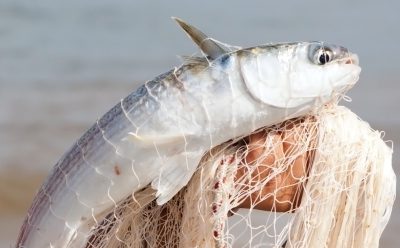
Those who supply our demand for fish haul up to 2.2 trillion animals from the ocean each year by means that are incredibly damaging to all forms of ocean life. Almost all of the wild-caught fish we eat today comes to us by way of longlining, beam or bottom trawling. Whilst subjecting fish to a slow and distressing death, usually by suffocation, the indiscriminate nature of these modern fishing techniques means that hundreds of other species are also inevitably killed in the process.
Today, for every 10 tuna, sharks, and other large predatory fish that were in our oceans 50 to 100 years ago, only one is left and that’s because we eat fish. If we continue, scientists predict that every species of wild fish—from tuna to sardines—will collapse by the year 2050.
FISH FARMNG IS FACTORY FARMING
As the ocean populations dwindle, so industrial farmers have set up intensive fish farms to keep their profits flowing. But fish belong in the vast ocean, not crammed into industrial systems where they are denied their natural habitats and food sources, and cannot express their natural behaviours.
Factory farming fish requires large amounts of chemicals to try and keep the animals alive within appalling conditions. But both these chemicals and the infestations they try to control escape the sea pens and harm the natural populations and the natural environment. There is nothing positive about fish farms.
we do not need fish to be Healthy
Fish contain omega 3 fatty acids, which is why some people think we need to eat them, but research shows that there are many other sources of omega 3 that have the same health benefits. When we eat walnuts, flax, and chia seeds we get all the goodness we need without all the dangerous elements of eating fish: the saturated fat and cholesterol, and the toxins including polychlorinated biphenyls (PCBs), dioxins, and mercury.
Fish Are Sentient Beings
It can be hard for us to imagine what a fish’s internal experience or perception might be like because they are so different from us. They live in another element, speak a language we cannot hear or understand, and we struggle to read their behaviour in the way we do with our wagging dogs and purring cats. Fish may not cluck, bleat, or squeal in terror the way a chicken, sheep, or pig headed for slaughter might. But they do suffer, and they do express their suffering. It’s just most of us do not know how to recognize the signs and, if we’re honest, perhaps we don’t really try to.
Fish Deserve Our Compassion
In response to substantial evidence gathered, fish biologists around the world now accept that fish do feel conscious pain, just like mammals and birds do. As with cats and dogs, we may never discover whether or not fish feel pain in exactly the same way we do, and yet there are parts of ourselves that we can recognize in fish—spines, pain receptors, endorphins, and all of the familiar pain reflexes—and these are the similarities that matter. Fish have the ability to feel pleasure and the ability to suffer, and so they ultimately deserve our compassion.
In his bestselling book Eating Animals, Jonathan Safran Foer asks some very important questions about the morality of eating fish.
“Is the suffering of a drawn-out death something that is cruel to inflict on any animal that can experience it, or just some animals? Just how distant are fish from us in the scheme of life? Is it a chasm or a tree that defines the distance? If we were to one day encounter a form of life more powerful and intelligent than our own and it regarded us as we regard fish, what would our argument be against being eaten? The lives of billions of animals a year and the health of the largest ecosystem on our planet [our oceans] hang on the thinly reasoned answers we give to these questions.”